
Service
Workflow & Systems Review
Where Every Dollar Actually Goes
Every business has a path money travels — a client pays, that payment lands somewhere, an expense gets charged, and eventually (hopefully) it all gets recorded correctly. A bookkeeping workflow review traces that path from end to end. Not the reports, not the chart of accounts — the actual movement. I look at how money enters your business, how it moves between accounts and platforms, and how it gets from a transaction to a categorized entry in your books. For a lot of wellness and creative businesses, that path has grown sideways over time: a payment processor added here, a new invoicing tool there, a habit of Venmo-ing a supplier because it was faster in the moment. Nothing about that is wrong — it's just rarely been looked at as a whole.
The Handoffs Where Things Break
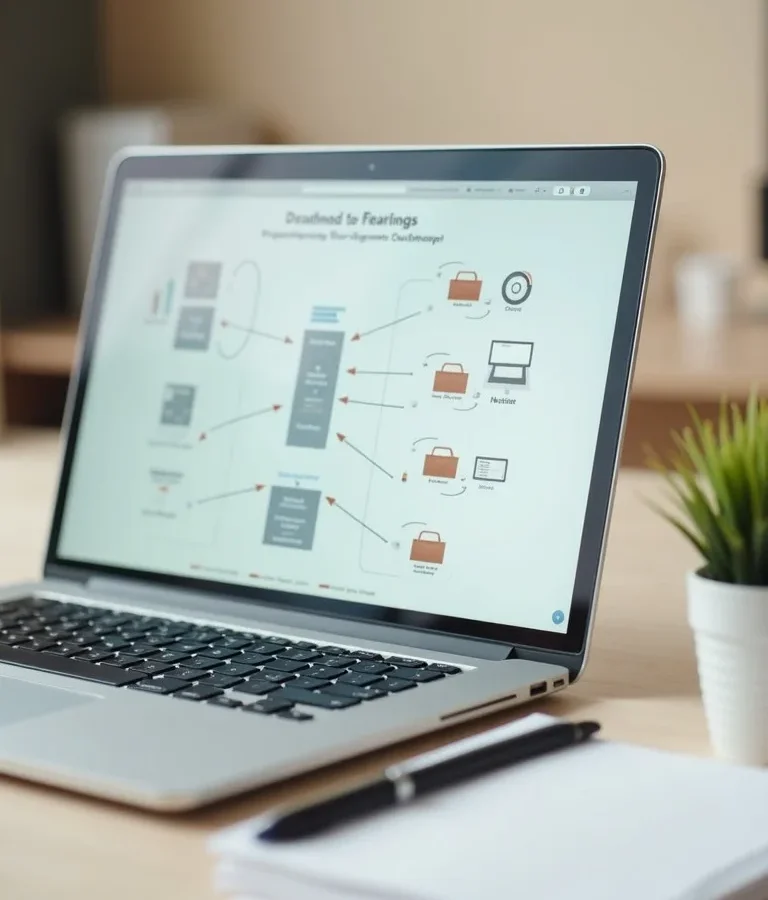
Errors and inefficiencies almost never happen inside a single tool — they happen in the handoff between tools. Money collected through Mindbody, Square, Stripe, or a client portal has to make it into your bank account and then into your books, and each transfer is a place where something can get missed, duplicated, or miscategorized. Add in a business owner who's also paying suppliers by card, by check, and occasionally out of pocket, and it's easy to lose track of what's actually been recorded versus what just feels handled. This review maps those handoffs specifically: where payments come in, how they're deposited, how expenses are captured, and how (or whether) that information consistently makes it into your books.
One Clear Path Instead of Five Workarounds
The goal isn't more tools — it's fewer decisions. Once I can see the full route money takes through your business, I can usually point to two or three specific places where the process is doing more work than it needs to: a manual step that could be automated, a platform that's being used inconsistently, a category that gets recorded five different ways depending on who's entering it. Simplifying a workflow doesn't mean overhauling your business. It means closing the gaps where transactions slip through cracks or get recorded differently every time, so the process holds up whether you're the one entering it or I am.
What You Walk Away With
You'll get a clear picture of how money currently moves through your business, where the friction points are, and specific recommendations for simplifying the process — fewer manual steps, fewer inconsistent categories, less room for something to be missed. If you're also working with me on monthly bookkeeping, this review becomes the foundation the ongoing work runs on. If you're not, it's still a useful, standalone answer to a question most business owners have asked themselves at some point: *how does money actually flow through my business, and why does it feel more complicated than it should?*
Start With How Your Business Actually Runs
This kind of review works well as its own project or alongside a broader financial diagnostic review. If your bookkeeping process feels more tangled than it should — too many platforms, too many manual steps, too much second-guessing — let's map it out together. Based in Sussex, Wisconsin and working with business owners across Southeast Wisconsin and virtually nationwide, I'll show you exactly where your workflow is working and where it's costing you time. Book a call to get started.